Patients often arrive in my clinic having been told they have "colorectal cancer", or "bowel cancer", or "cancer of the large intestine" — and they are unsure which it actually is. The distinction matters, because although colon and rectal cancer start from the same type of cell, they sit in different places, behave differently, and are treated differently.
Where they are
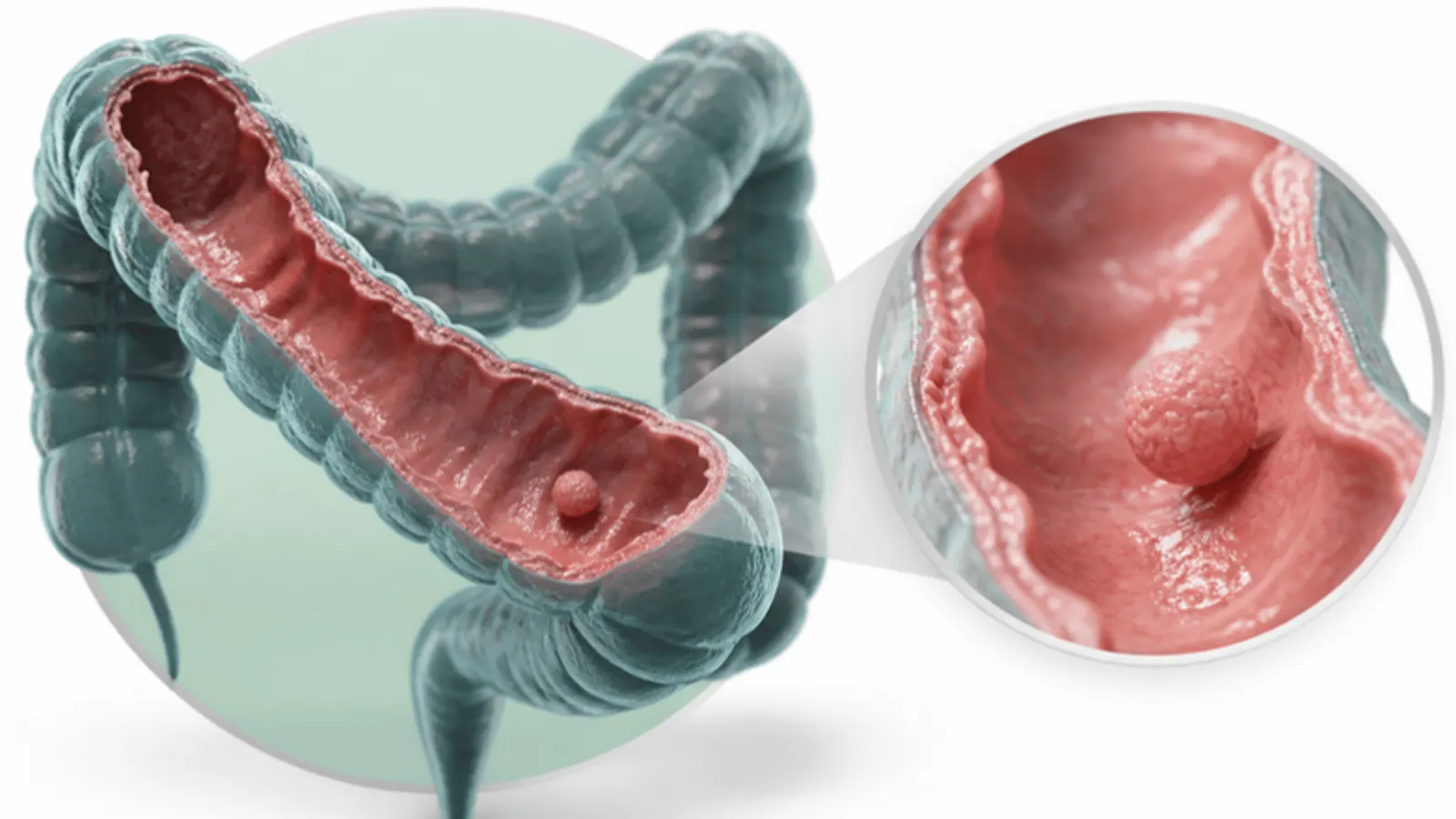
The large intestine is roughly 1.5 metres long. The colon makes up most of it — running up the right side of the abdomen, across the top, and down the left. The rectum is the last 12 to 15 centimetres, sitting deep in the pelvis just above the anus. Cancer in the colon is colon cancer. Cancer in the rectum is rectal cancer. "Colorectal cancer" is simply the umbrella term.
How symptoms differ
Colon cancer, especially on the right side, often causes no bowel symptoms at all for a long time. The tumour bleeds slowly into a wide bowel, and the first sign may be tiredness and breathlessness from anaemia, or vague abdominal discomfort, or weight loss. Left- sided colon cancer more often causes a change in bowel habit, cramping, and visible blood.
Rectal cancer is closer to the exit, so it tends to announce itself earlier: bright red bleeding, a sense of needing to go urgently or repeatedly without passing much (called tenesmus), narrow or ribbon-shaped stools, and mucus. These are the symptoms most often mistaken for piles.
How the tests differ
Both are diagnosed by colonoscopy and biopsy, and both are staged with a CT scan to check for spread. The key difference is that rectal cancer needs an MRI of the pelvis. The MRI shows exactly how deep the tumour has grown, how close it is to the sphincter muscles and the surrounding tissue, and whether lymph nodes are involved. That image decides the entire treatment plan.
How treatment differs
Colon cancer is usually treated with surgery first. The affected segment of colon is removed along with its lymph nodes, and the two ends are joined. Chemotherapy may follow if the lymph nodes contain cancer. Most of this can be done laparoscopically, with a 4 to 6 day stay.
Rectal cancer is more complex because the rectum sits in a narrow, bony pelvis surrounded by nerves that control bladder and sexual function, and ends at the sphincter. For many rectal cancers, chemoradiotherapy is given first to shrink the tumour, and surgery follows 8 to 12 weeks later. The operation — total mesorectal excision, or TME — removes the rectum with its surrounding fatty envelope intact, which is what gives the best chance of cure. Laparoscopic and robotic approaches are particularly valuable here, because the camera can see into corners the human eye cannot.
For a small group of rectal cancer patients whose tumour vanishes completely after chemoradiotherapy, a "Watch and Wait" approach may avoid surgery altogether, under very close surveillance.
The question everyone asks: will I need a bag?
For colon cancer, almost never. For rectal cancer, most patients avoid a permanent stoma thanks to sphincter-preserving surgery, but some need a temporary stoma for a few months while the join heals, and a minority with very low tumours need a permanent one. This is the single most important conversation to have with your surgeon before surgery, and it is why a dedicated colorectal specialist matters.
Recovery
Colon cancer surgery: home in 4–6 days, normal activity in 3–4 weeks. Rectal cancer surgery: home in 5–7 days, normal activity in 4–6 weeks, with bowel function continuing to settle over several months.
Questions
Treatment information
Colon Cancer SurgerySources
- NCCN Clinical Practice Guidelines in Oncology — Colon Cancer and Rectal Cancer (current versions, nccn.org).
- Glynne-Jones R et al. Rectal cancer: ESMO Clinical Practice Guidelines for diagnosis, treatment and follow-up. Ann Oncol 2017;28(suppl 4):iv22–iv40.
- Heald RJ, Ryall RD. Recurrence and survival after total mesorectal excision for rectal cancer. Lancet 1986;1:1479–1482.
- Bonjer HJ et al. (COLOR II). A randomized trial of laparoscopic versus open surgery for rectal cancer. N Engl J Med 2015;372:1324–1332.

Dr. Wasif Raza
MBBS, MS, MCh (Colon & Rectal Surgery, UK), FRCS (UK), FACS (USA). Colon & Rectal Cancer, Laparoscopic & Robotic Surgery, and General Surgery Specialist, Apollo Medics Superspeciality Hospitals, Lucknow. Reg. NMC 08-33828 · GMC 7555694.
Appointments: +91 92780 72150. This content is for information only and is not a substitute for consultation. Individual results vary.